

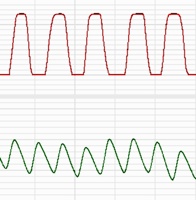
In many acute and chronic pain conditions, pain has a throbbing quality that has long been attributed to the activation of sensory neurons by blood flow pulsations. Now, Andrew Ahn and colleagues at the University of Florida, Gainesville, US, challenge that view: In research published in the May 30 Journal of Neuroscience, they report that the throbbing rate is slower than the arterial pulse rate in patients with acute dental pain, and that the two rhythms show no synchrony. Understanding the mechanism of throbbing could provide important insight into treating one of pain’s most disabling characteristics.
Co-first authors Afia Mirza and Jue Mo and their colleagues measured arterial pulse and self-reported throbbing rates in 29 patients with acute dental pain and found that, as observed in Ahn’s earlier study of migraine patients (Ahn, 2010), the average throbbing rate was slower than the average pulse rate—44 beats per minute (bpm) for throbbing, compared with 73 bpm for pulse. In addition, the rates were independent, such that those patients with higher pulse rates, for example, did not have higher throbbing rates. Still, it was possible that pulse might drive throbbing indirectly—pain might throb with every other heartbeat, for instance. However, no synchrony was evident. Fluctuations in throbbing rate did not follow variations in pulse rate, either.
The results suggest that throbbing pain has little to do with pulse rate, and beg the question: What does set the pace? Ahn expects that throbbing is not a primary sensation, but rather a perception that arises somewhere in the brain. “If it’s not a sensation, then maybe it’s a perception,” he said. “And if it is a perception, what are the neurophysiologic mechanisms that drive it?”
Meanwhile, an important question is whether the temporal properties of throbbing migraine and dental pain are similar in other pain conditions. If so, that could suggest that throbbing has a common neurophysiologic basis, which could simplify future treatment efforts.
Image: In a patient with throbbing dental pain, the throbbing rate (top) is slower than the arterial pulse rate (bottom). Credit: A. Ahn.


Comments
Vania Apkarian, Northwestern University Medical School
Aristotle’s wife, and fractal pain
I want to congratulate Andrew Ahn and colleagues on their clever study demonstrating that throbbing toothache pain is not correlated to arterial pulsation. The study is elegant in its simplicity and completeness, as the authors clearly show that throbbing toothache pain occurs at a lower frequency, with a higher fractal dimension, and without phase locking to the arterial pulse. The results debunk a long-standing assumption, and expounds on their earlier, more preliminary report, that throbbing headaches are also not related to the arterial pulse.
Before I explain my specific excitement with the study, let me digress and invoke Aristotle (yes, he is relevant yet again in pain research!). He has been accused of at least not liking Mrs. Aristotle based on statements like: "The female is more dispirited and more despondent than the male, more shameless and more lying, readier to deceive and possessing a better memory for grudges," but more relevant to the current subject, he also claims that women possess less teeth than men. Based on such pronouncements, he has been accused of misogyny (but see: http://bmcr.brynmawr.edu/2004/2004-09-19.html). A more important accusation is his failure, or unwillingness, to look inside the mouth of Mrs. Aristotle. The simple act of counting her teeth would have demonstrated to Aristotle his mistake. The message from Aristotle’s story applies directly to throbbing pain, where the simple act of measuring (even in the absence of any tools other than just a clock), would have shown the error of the long-standing assumption that link throbbing pain to blood pressure. Thus, the most important part of the study is the actual act of measuring. This is, in fact, the most important concept of modern science (perhaps first understood by Galileo), namely that prior to theorizing, one needs a measurement.
Additionally, I am especially delighted with the report by Ahn and colleagues, as it extends our own studies of measuring fluctuations of spontaneous pain in clinical pain conditions. We have asked pain patients to rate the fluctuations of the magnitude of ongoing pain [1]. Ahn and colleagues specifically instruct subjects to rate throbbing pain. In our study, we showed that the fractal dimension of the variability of pain is distinct for different chronic pain patients, and it seems that the fractal dimension reported for throbbing pain is more similar to the spontaneous pain across multiple chronic pain conditions, than to the arterial pulse. Thus, Ahn’s study demonstrates that subscales for ongoing pain can also be studied by subjective rating. My hope has been, and perhaps the current report will enhance the possibility, that other scientists will also use the method of dynamic subjective ratings to study clinical pain conditions, with or without brain imaging. I should add that for those who are interested, we can supply them with proper equipment (for a nominal cost) that would enable monitoring fluctuations of clinical pain, even in conjunction with brain imaging.
Reference:
[1] Foss JM, Apkarian AV, Chialvo DR. Dynamics of pain: fractal dimension of temporal variability of spontaneous pain differentiates between pain states. J Neurophysiol 2006;95(2):730-736.